
The global power tool market continues to expand in 2026, driven by infrastructure projects, professional contractors, and the growth of DIY retail channels.
For distributors, however, the key question is no longer just which brand sells best — but:
Should you partner with a global brand, or work with an OEM manufacturer?
This article breaks down the strategic differences and what distributors should consider before making a decision.
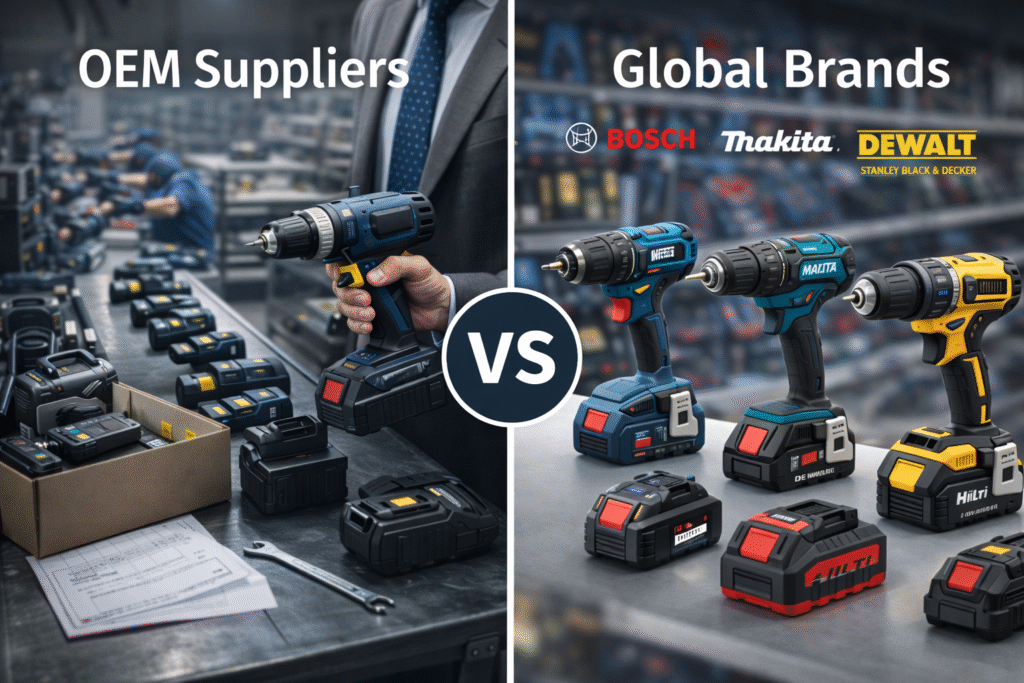
1️⃣ Global Brands: Strength, Stability, and High Entry Barriers
When we talk about global brands, companies like:
come to mind.
Advantages:
Strong brand recognition
Marketing support
Established product reliability
Consumer trust
Challenges for Distributors:
Strict territory control
High minimum order quantities (MOQ)
Limited pricing flexibility
Lower gross margins
Little product customization
In many Southeast Asian markets, distributors of global brands compete mainly on price — not strategy.
2️⃣ OEM Manufacturers: Flexibility and Margin Control
OEM (Original Equipment Manufacturer) partnerships allow distributors to build their own brand or operate with private labels.
Key Advantages:
✔ Better Margin Structure
Without heavy global marketing costs, OEM products typically allow higher gross margins.
✔ Product Customization
Voltage, packaging, branding, and even tool specifications can be adapted to local markets.
✔ Market Flexibility
Distributors can:
Adjust pricing faster
Launch exclusive SKUs
Build long-term brand equity
✔ Certification Support
In regulated markets like Thailand, certification such as TISI is mandatory.
Experienced OEM factories often support the certification process together with distributors, reducing compliance risks.
3️⃣ 2026 Market Reality: What Has Changed?
In 2026, several trends are shaping distributor decisions:
🔹 1. Cost Pressure Is Increasing
Currency fluctuations and freight volatility make margin control critical.
🔹 2. Mid-Tier Brands Are Growing Faster
Many emerging markets are seeing growth in the mid-range segment — not premium tools.
🔹 3. Private Label Is No Longer “Low-End”
Modern OEM manufacturers now offer:
Brushless motors
Lithium battery platforms
Professional-grade durability
The quality gap between global brands and top-tier OEM factories is narrowing.
4️⃣ Key Questions Every Distributor Should Ask
Before choosing between OEM and global brands, distributors should evaluate:
What margin level is sustainable in your market?
Do you want long-term brand ownership?
How important is product differentiation?
Do you have marketing capability locally?
Are certification and compliance manageable alone?
The right decision depends on your strategic positioning — not just brand prestige.
5️⃣ A Hybrid Strategy: The Emerging Model
More distributors in 2026 are adopting a hybrid approach:
Carrying one established global brand for credibility
Developing a private-label OEM line for profitability
This structure allows:
Brand trust from big names
Margin strength from private label
Reduced business risk
6️⃣ Final Thoughts
There is no universal “better” choice.
Global brands offer stability and recognition.
OEM partnerships offer control and scalability.
For distributors focused on Southeast Asia and emerging markets, the real competitive advantage often lies in:
Supply chain agility
Certification capability
Customization flexibility
Margin optimization
The key is choosing a manufacturing partner who understands your market, not just your order quantity.